

According to Statistics Canada, 28.2% of businesses using AI in the second quarter of 2026 used it for virtual agents or chatbots. The question is which of the two you need.
AI agent vs chatbot: one answers, the other answers and acts
A chatbot is software that answers questions in a chat window. Most of the time, it follows a script or a list of frequent questions.
Québec's official terminology dictionary, the Grand dictionnaire terminologique, describes it as a simple agent limited to a few repetitive tasks.
An AI agent understands the request the way the client wrote it, finds the answer in your information and acts in your tools. It books, updates your CRM (the software where you track your clients) or hands off to a person.
Example
A client writes: "I can't make it Tuesday, do you have anything Thursday after 4 p.m.?"
The chatbot doesn't find this question in its script. It shows your phone number and your opening hours.
The agent checks your calendar and offers Thursday at 4:30. Once the client agrees, it moves the appointment and notes the change in their record.
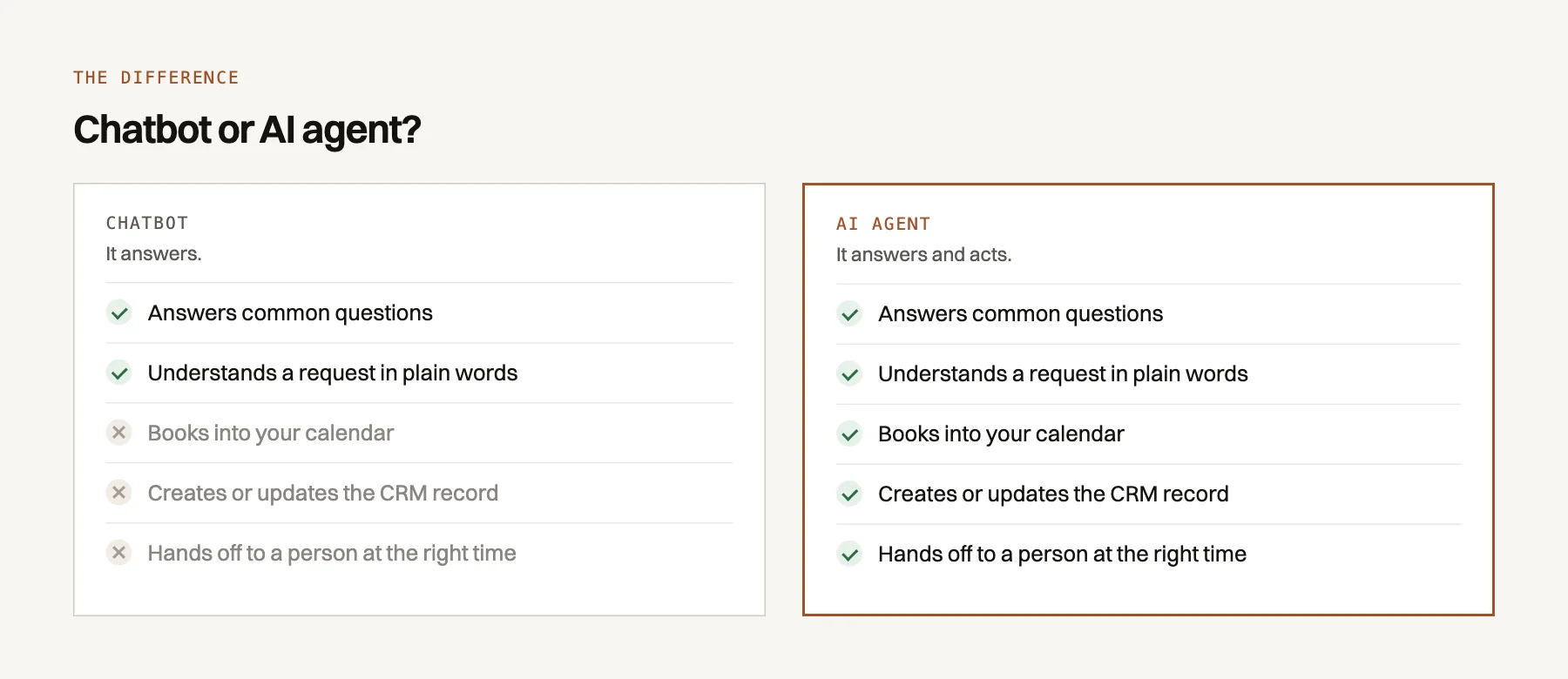
The comparison: what each one does, and what can go wrong
| Criterion | Chatbot | AI agent |
|---|---|---|
| What it does | Answers the questions it was given | Understands the request, answers and takes an action |
| Example | "What are your hours?" | "Move my appointment to Thursday." |
| When it is enough | Few questions, always the same, nothing to do afterwards | Requests lead to booking, qualifying or following up |
| Setup | A subscription, and your frequent questions typed in | Your information, rules, connections to your tools and testing |
| Main risk | A rigid or off-topic answer, and a client who gives up | A wrong action in your name, hence a handoff to a person |
A good FAQ page is often enough, with no chatbot at all
If the same five questions keep coming back and no task follows the answer, start simple. A clear, up-to-date FAQ page already handles a good share of messages.
Example
A snow removal company mostly gets three questions: areas served, the price of the season and the sign-up deadline.
A FAQ page and an automatic email reply that links to it cover all three, with no extra software.
When messages pile up, an off-the-shelf chatbot can take over. These tools are sold as subscriptions, and you type in the answers yourself.
Our web design for small businesses page shows how to build it around your clients' questions. Few inquiries at all? The problem lies elsewhere: see why a business gets no leads online.
An AI agent is worth it when each message leads to a task
The key question is not "how many messages?" but "what do I have to do after answering?" If the answer is always a task in your tools, an agent can do it for you.
- Book or reschedule. The client picks a slot, the agent puts it in your calendar and sends the confirmation.
- Qualify a quote request. The agent asks for the address, the timing and the budget, then sends you a complete file.
- Fill in your CRM. Each new inquiry becomes a record instead of sleeping in your inbox.
- Hand off. A complaint or a delicate question comes to you, with a summary of the exchange.
That is daily life for a real estate broker juggling visit requests, or for a professional services firm sorting new mandates.
Example
You get 10 appointment requests a week. Finding a slot takes 3 emails of 5 minutes each, so 150 minutes a week.
That is about 11 hours a month. If your hour is worth $60, those hours are worth about $650 a month.
An agent needs a place to write. If your clients are scattered across emails and a spreadsheet, a CRM comes first. At Urban Gardeners, every quote request now lands in a CRM and gets followed up.
A subscription for a chatbot, a tailored project for an agent
An off-the-shelf chatbot is paid by subscription. You set it up yourself, and it stays limited to the answers you typed in.
An AI agent takes more work: connecting your tools, writing its rules and testing it on real questions. Our projects usually fall between $999 and $4,999 to start, then between $199 and $999 a month.
The monthly cost covers hosting, follow-up and AI usage. The exact price is fixed in writing after a free 30-minute AI diagnostic. For what moves that price, see what an AI agent costs a small business.
There is a third path between the two. An automation with no conversation, such as a form that creates the record and sends the confirmation, sometimes does the job for less.
The test: is an AI agent worth it for you?
Five questions are enough. The more boxes you tick, the more likely an agent is to pay off.
AI agent or chatbot: which one do you need?
Tick what is true for you; nothing is sent. 3 or more: an AI agent is worth a closer look. Fewer than 3: a FAQ page or a simple chatbot is probably enough for now.
Tick the statements to see your result.
The real risk: a wrong answer given in your name
Chatbot or agent, you are responsible for what it tells your clients. A 2024 decision in British Columbia showed it, and the lesson applies to any business.
Air Canada's chatbot told a customer he could apply for a bereavement fare after travelling, within 90 days. That was wrong: the airline's own webpage said the opposite.
British Columbia's Civil Resolution Tribunal, which hears small claims, held the airline responsible for all the information on its website. A static page or a chatbot made no difference. Air Canada had to pay $812.02, including damages, interest and fees.
An agent that acts raises the stakes: an error can become a misplaced appointment. Ask any provider for four safeguards:
- It answers only from information you approved.
- It says "let me check with the team" rather than making something up.
- It hands off to a person for a complaint, a refund or an unusual case. You receive the conversation and its summary.
- You reread its conversations, especially in the first weeks.
Frequently asked questions
Is ChatGPT a chatbot or an agent?
Used as is, it is an assistant that answers and drafts from what you give it. An agent for your business is connected to your calendar or CRM and follows the rules you approved.
Will my clients know they are talking to a machine?
They should. The simplest way is for the agent to introduce itself as a virtual assistant in its first message. The client can ask for a person at any time.
Can an existing chatbot be turned into an agent?
Sometimes. If your current tool offers an API or connectors, actions can be added to it. Otherwise, it is often simpler to start again from your frequent questions, which become the agent's base.
Can the agent answer by email or text message?
Yes. It can answer on your website, in your inbox or by text message, depending on your tools. We start with the channel where most of your requests arrive.
How long does it take to put an agent online?
Between 1 and 4 weeks of building and testing, after a plan and a fixed price delivered in 3 days. More tasks and tools bring you closer to four weeks.